
The High Pain Threshold Paradox
Some people are very good at pain.
They cope.
They carry on.
They keep functioning.
They don’t want to make a fuss.
They push through discomfort, pressure, fatigue, stress, and symptoms.
Often, this is not weakness.
It is strength.
It may be the strength that helped them work, parent, compete, care for others, build a life, survive difficult experiences, and keep going when stopping did not feel possible.
But in persistent pain, this strength can sometimes become part of the problem.
Not because the person is doing anything wrong.
But because the nervous system may have learned that pain, tension, pressure, and emotional discomfort are things to override rather than listen to.
This is what I think of as the high pain threshold paradox.
The person may have a very high tolerance for physical pain, but a much lower tolerance for the emotional state that comes with pain.
The frustration.
The fear.
The helplessness.
The uncertainty.
The loss of control.
The exhaustion.
The anger.
The grief.
The feeling of being trapped in a body that no longer behaves as expected.
Sometimes the pain itself is not the only thing the system is reacting to.
Sometimes it is the meaning of the pain.
Guided practice: using strength differently
If this idea resonates, I’ve recorded a short guided practice to go with this blog.
It is for anyone who recognises themselves as someone who can push through pain, but finds the frustration, fear, exhaustion or uncertainty around persistent pain much harder to tolerate.
This is not about becoming weaker. It is about using strength differently when pushing through no longer works.
“I can cope with pain”
Many people with persistent pain have spent years proving they can cope.
They may have worked through injury.
They may have exercised through symptoms.
They may have stayed calm for others.
They may have ignored their own needs.
They may have been praised for being tough, reliable, resilient, or low-maintenance.
They may even say things like:
“I’ve always had a high pain threshold.”
“I just get on with it.”
“I don’t like stopping.”
“I’m used to pushing through.”
“I’ve dealt with worse than this.”
And often, they are telling the truth.
They are strong.
But strength has a direction.
And if strength is always directed towards pushing, fighting, bracing, fixing, proving, or carrying on, the body may never get the message that it is safe to soften.
When pushing through stops working
Pushing through can be useful in the short term.
It can help us meet a deadline, finish a shift, get through a difficult day, or manage a crisis.
But the nervous system is always learning.
If the body repeatedly receives the message, “We do not stop until things are unbearable,” it may begin to become more protective.
If discomfort is repeatedly ignored, the system may have to turn the volume up.
If emotional distress is repeatedly overridden, the body may carry more tension, vigilance, and alarm.
If the only strategy is to fight through, the system may never learn another way.
This does not mean the pain is imagined.
It does not mean the person caused it.
It simply means the pain system may be responding to a long-standing pattern of pressure, protection, and survival.
This also connects with the idea that pain patterns can give us useful clues. Sometimes the pattern is not only where pain appears, but how we respond to it when it does.
The emotional layer of pain
Pain is not only a sensation.
Pain often comes with an emotional atmosphere.
For one person, pain may bring fear:
“What if something is seriously wrong?”
For another, it may bring frustration:
“Why is this still happening?”
For another, it may bring shame:
“I should be coping better.”
For another, it may bring grief:
“I miss the person I used to be.”
For another, it may bring helplessness:
“I don’t know what else to do.”
These emotional states are not separate from the body.
They are felt in the body.
Fear changes breathing, muscle tone, attention, movement, and sensitivity.
Frustration can create bracing and urgency.
Helplessness can create collapse.
Shame can make us hide, withdraw, or push even harder.
Grief can feel heavy, tired, and immovable.
So when a person says, “I can tolerate pain,” that may be true.
But the deeper question might be:
Can I tolerate what pain makes me feel?
A different kind of strength
This is where the recovery process can become surprisingly challenging.
Because the invitation is not simply to become stronger.
The person is already strong.
The invitation may be to use that strength differently.
Not to push harder.
Not to fight the body.
Not to win a battle against symptoms.
But to pause.
To feel.
To listen.
To soften.
To stay present.
To allow the body to be heard without immediately trying to dominate it.
For someone who has survived by pushing through, this can feel unfamiliar. It can even feel unsafe.
Rest can feel lazy.
Softness can feel weak.
Feeling can feel dangerous.
Letting go can feel like losing control.
But sometimes recovery begins when the person realises:
“I do not have to keep proving I can cope.”
The body may not need more force
Many people with persistent pain have already tried force.
They have tried more discipline.
More stretching.
More strengthening.
More research.
More appointments.
More supplements.
More effort.
More analysis.
More control.
Sometimes these things are useful.
But sometimes the missing ingredient is not more force.
Sometimes it is safety.
The body may not need to be conquered.
It may need to be reassured.
It may need to learn that pain does not always mean danger.
It may need to learn that rest is allowed.
It may need to learn that emotion can be felt without being overwhelming.
It may need to learn that strength can include gentleness.
This is not passive.
It takes courage to stop fighting a body you have been afraid of.
It takes courage to feel what you have been overriding.
It takes courage to pause when every old pattern says, “Keep going.”
The paradox
This is the paradox.
The person who can tolerate huge amounts of physical discomfort may struggle to tolerate uncertainty.
The person who can push through pain may struggle to sit with fear.
The person who can keep functioning may struggle to admit exhaustion.
The person who looks strong on the outside may be in a constant internal battle.
So the work is not to take their strength away.
The work is to honour it first.
To say:
“Your strength helped you survive.”
“Your ability to carry on makes sense.”
“You did what you knew how to do.”
“And now, perhaps, that same strength can be used in a new way.”
Not to override.
But to allow.
Not to force.
But to feel.
Not to push through the body.
But to build a different relationship with it.
A question worth asking
If you recognise yourself in this pattern, you might gently ask:
“What am I actually struggling to tolerate?”
Is it the pain itself?
Or is it the fear that comes with it?
The frustration?
The helplessness?
The loss of control?
The uncertainty?
The feeling that your body has let you down?
The pressure to get better quickly?
The belief that stopping means failing?
You do not need to answer immediately.
Just asking the question can begin to shift the relationship.
Because once you see the emotional layer, you may no longer need to fight the pain quite so blindly.
You may begin to meet the whole experience with more understanding.
Recovery may ask for a new form of resilience
Resilience is often misunderstood.
We think of resilience as pushing through.
But sometimes resilience is the ability to pause before reacting.
Sometimes it is the ability to rest without guilt.
Sometimes it is the ability to feel fear without obeying it.
Sometimes it is the ability to move gently when the body expects danger.
Sometimes it is the ability to say, “I am safe enough right now.”
Sometimes it is the ability to stop treating your body like an enemy.
This kind of resilience is quieter.
It may not look impressive from the outside.
But inside the nervous system, it can be powerful.
A gentler way forward
If you have a high pain threshold, you do not need to criticise that part of yourself.
It may have served you well.
It may have helped you through difficult times.
It may have kept you going when you needed to keep going.
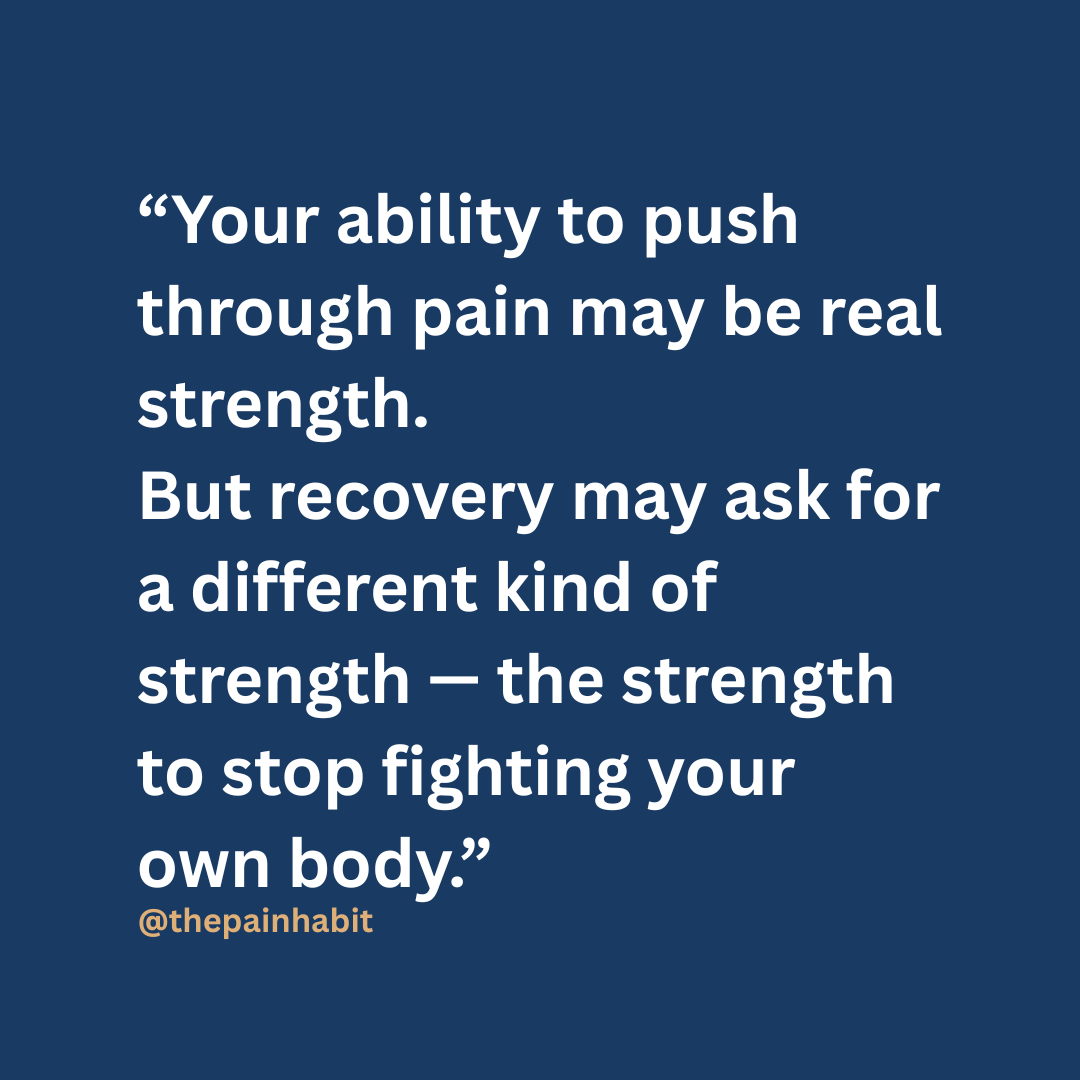
But perhaps recovery is not asking you to become less strong.
Perhaps it is asking you to become strong enough to soften.
Strong enough to listen.
Strong enough to feel.
Strong enough to stop fighting your own body.
Because sometimes the next step is not to push through more pain.
Sometimes the next step is to notice what pain brings up — and meet that part of you with compassion.
That may be where the nervous system begins to learn something new.
Try the guided practice
If you recognise this pattern in yourself, the next step does not need to be more analysis or more effort.
It may simply be to notice what pain brings up emotionally — frustration, fear, exhaustion, helplessness, pressure — and practise meeting that with a little less fight.
You can listen to the companion guided practice here:
FAQs
Does having a high pain threshold mean the pain is not serious?
No. A high pain threshold does not mean pain should be ignored or dismissed. Pain is always worth listening to, especially if it is new, worsening, unexplained, or associated with other concerning symptoms.
The point is not to prove that pain is harmless. The point is to notice whether the usual response to pain has become pushing, fighting, bracing, or overriding — and whether that pattern is helping or keeping the system on alert.
Is this saying I caused my pain by pushing through?
No. This is not about blame.
Many people learned to push through because they had to. It may have helped them cope, work, parent, compete, care for others, or survive difficult experiences.
The question is not, “Did I cause this?”
A kinder question might be:
“What has my nervous system learned, and what might it need to learn now?”
Can emotional stress really affect physical pain?
Yes. Emotional stress can affect breathing, muscle tension, sleep, hormones, immune activity, attention, movement, and nervous system sensitivity.
That does not mean the pain is imaginary. It means the body and nervous system are connected. Fear, frustration, pressure, grief, and helplessness can all be felt physically.
What if I really do have a physical problem?
You might.
Persistent pain is not always one thing. There may be tissue irritation, joint sensitivity, nerve involvement, inflammation, or other medical factors involved.
But even when there is a physical issue, the nervous system can still become more sensitive and protective. Understanding the emotional and protective layers does not mean ignoring the body. It means looking at the whole picture.
How do I know if I am pushing through too much?
You might notice that you rarely stop until symptoms force you to. You may feel guilty resting, frustrated by limits, or afraid that slowing down means going backwards.
You may also notice that your body has to shout before you listen.
That can be a useful clue — not a criticism.
What is the first step if I recognise this pattern?
Start gently.
You do not need to stop everything or analyse every symptom. You might simply begin by noticing what pain brings up emotionally.
Fear?
Frustration?
Pressure?
Helplessness?
Anger?
Grief?
A need to fix it quickly?
Sometimes the first step is not doing more.
Sometimes it is listening differently.
You don’t have to figure this out alone. Here are some helpful next steps…
Join our FREE private Facebook group The Pain Habit Community, and connect with people who have recovered or are on their way.
Sign up for The Pain Habit Blog below to receive future insights.
Subscribe to The Pain HabitYouTube channelfor weekly guidance.
Buy The Pain Habit book.Order here.
But truly — take what you need, in your own time.