
The Fish That Never Knew It Was in Water
"A fish doesn't know it's surrounded by water. It simply assumes that's what life is."
Perhaps we're not so different.
One of the most common concerns I hear from people living with persistent pain is this:
"I don't think anything bad happened to me."
Sometimes it is spoken with relief.
Sometimes with confusion.
Sometimes with almost a sense of guilt, as though they worry their pain can't possibly make sense because their childhood was happy.
My answer is always the same.
Then let your happy childhood remain a happy childhood.
There is no value in searching for darkness where none exists.
No value in rewriting loving memories.
No value in blaming parents who did the very best they could.
This journey isn't about finding fault.
It's about becoming curious.
The Water We Never Notice
A fish never notices the water because it has never known anything else.
In many ways, neither do we.
We don't simply grow within a family.
We grow within an emotional environment.
Within hopes.
Within expectations.
Within fears.
Within love.
Most of it is never spoken aloud.
It simply becomes normal.
Sometimes Love Carries a Story
Imagine a couple who have experienced the heartbreaking loss of a child.
Years later another baby is born.
That child arrives into extraordinary love.
Extraordinary gratitude.
Extraordinary care.
The parents are not trying to create pressure.
Quite the opposite.
They simply know, perhaps more deeply than most, how precious life can be.
Without anyone intending it, the emotional atmosphere of the home may carry an unspoken message:
"You matter beyond words."
"Please stay safe."
"We couldn't bear to lose you."
The child doesn't consciously hear these words.
Yet children are exquisitely sensitive to the emotional worlds they grow within.
This isn't a theory about cause.
It isn't blame.
It is simply one example of how the water surrounding us may quietly influence the way our nervous system learns what safety feels like.
Love Can Become Pressure Without Anyone Meaning It To
For some people, the pressure to achieve doesn't grow from criticism.
It grows from connection.
From wanting to protect relationships.
From wanting to make those we love proud.
From never wanting to become a source of disappointment or worry.
The result?
A wonderfully capable adult.
Reliable.
Thoughtful.
Compassionate.
Hard-working.
Always available.
Always coping.
Always striving.
These are beautiful qualities.
Many people build meaningful lives because of them.
But sometimes the nervous system never learns that it can rest.
The Clue I Didn't Expect
Recently, I was talking with someone who described a loving childhood.
As we gently explored her story, I said,
"Sometimes the pressure we carry doesn't come from obvious trauma. Sometimes it simply comes from the emotional environment we grew up in."
Her immediate response wasn't about herself.
It was,
"My mum and dad wouldn't like me saying that."
That stopped us both for a moment.
She wasn't defending herself.
She was instinctively protecting her parents.
That wasn't evidence of a bad childhood.
If anything, it reflected how deeply connected she still felt to them.
But it also revealed something important.
Even while considering her own experience, her attention naturally moved towards caring for somebody else's feelings first.
That pattern had become so familiar she had never noticed it.
Like the fish.
When the Body Finally Speaks
Many people I meet have no serious disease.
No significant injury.
No structural explanation that fully accounts for the pain they have lived with for months or years.
Yet the pain is absolutely real.
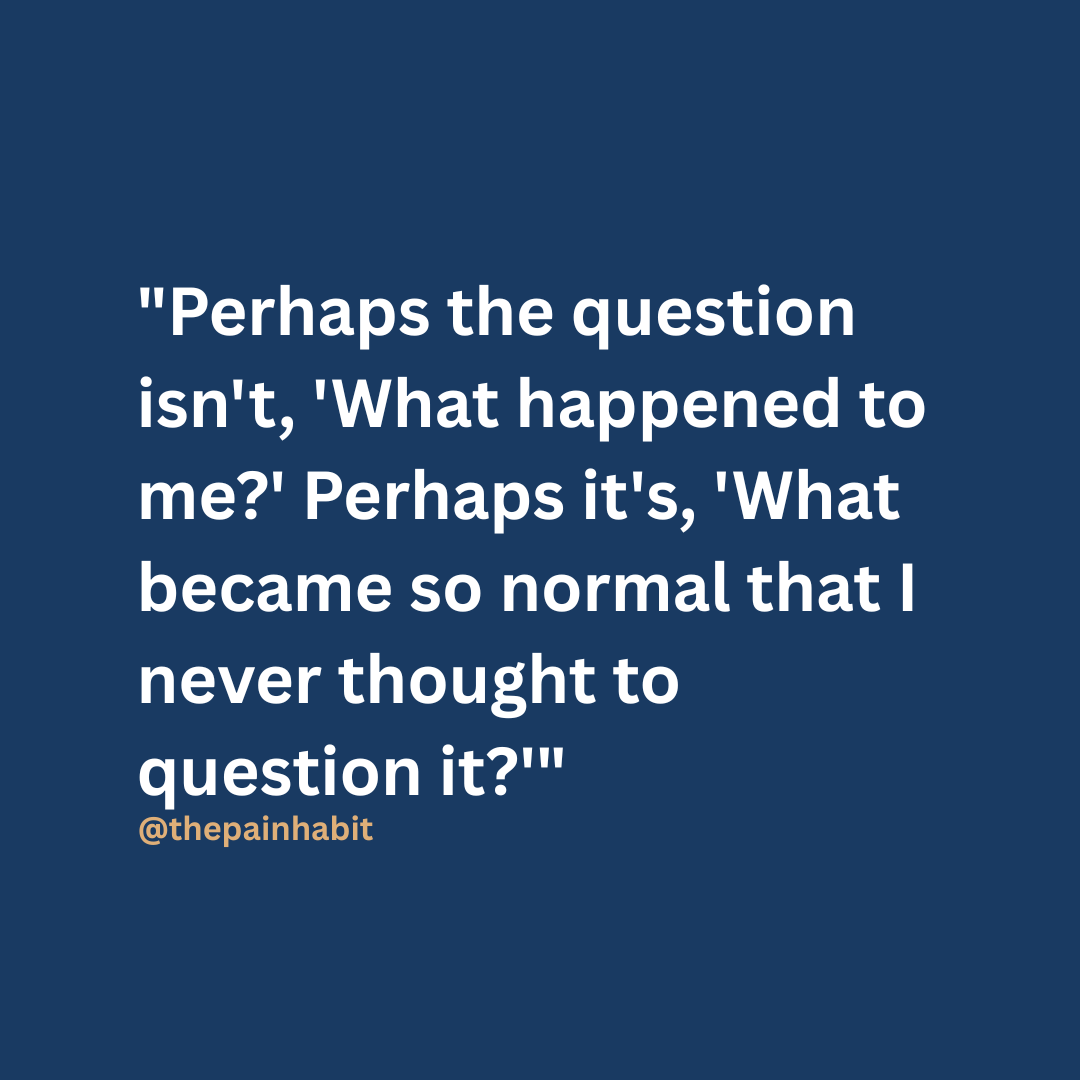
Perhaps the question isn't,
"What terrible thing happened to me?"
Perhaps it is,
"What became so normal that I never thought to question it?"
Maybe your nervous system learned that love meant responsibility.
Maybe safety meant pleasing.
Maybe belonging meant achieving.
Maybe none of those things were ever spoken aloud.
They simply became the water you learned to swim in.
Freedom Doesn't Mean Becoming Someone Else
One of my favourite parts of these conversations is that nobody has to lose who they are.
You don't have to stop being a wonderful parent.
Or an ambitious business owner.
Or a caring partner.
Or a dependable friend.
Perhaps your nervous system isn't asking you to become someone different.
Perhaps it is simply asking whether you could carry all of those beautiful qualities...
...with just 5% less pressure.
Sometimes that small shift changes everything.
Not because your life has changed.
But because your relationship with your life has.
A Final Thought
You don't need to search for hidden trauma.
You don't need to invent darkness.
You don't need to blame the people who loved you.
Instead, perhaps just become curious.
What if your nervous system has simply been living inside an emotional climate that felt so normal, you never realised it was there?
A fish never notices the water.
Until one day it does.
And awareness doesn't change where the fish came from.
It simply gives it the freedom to swim differently.
Awareness isn't about replacing one certainty with another.
You don't need to decide that your childhood caused your pain, just as you don't need to decide it had no influence at all. The invitation is simply to become curious. Sometimes the moment we stop trying to prove a story and start noticing our present patterns, the nervous system begins to feel a little safer.
If this article resonated with you, perhaps don't ask whether something terrible happened in your past. Instead, become curious about the invisible pressures your nervous system may have learned to carry. Awareness isn't about blame—it's about creating the conditions for change.
Frequently Asked Questions
Do I need to have experienced trauma to develop persistent pain?
No. Many people living with persistent pain describe happy, loving childhoods and have no history of obvious trauma. Persistent pain is complex and rarely has a single explanation. Sometimes the nervous system develops protective patterns through subtle, everyday experiences rather than major life events.
Can loving parents still influence my nervous system?
Yes—but not through blame or poor parenting.
Every parent brings their own life experiences into the family, including hopes, worries and ways of responding to stress. Children naturally grow within that emotional environment. In some people, those experiences may contribute to patterns of responsibility, vigilance or perfectionism that continue into adult life.
Does this mean my childhood caused my pain?
No.
Persistent pain is influenced by many interacting factors, including biology, lifestyle, physical health, emotions, beliefs, stress, sleep and previous experiences.
This article simply invites curiosity about one possible influence, not a definitive cause.
What if I genuinely had a wonderful childhood?
Then hold onto that.
The aim isn't to search for hidden problems or rewrite happy memories. Instead, ask yourself:
"What became so normal in my life that I never questioned it?"
Sometimes the answer isn't trauma. It may simply be the quiet pressure to always cope, always achieve or always look after everyone else.
Can reducing pressure really help persistent pain?
For many people, yes.
Reducing pressure doesn't mean giving up on your ambitions or responsibilities. It means noticing where you may be demanding more from yourself than your nervous system can comfortably sustain.
Sometimes even small changes in self-expectation, recovery, rest and self-compassion can help calm an overprotective nervous system.
If my scans are normal, does that mean the pain isn't real?
Absolutely not.
Persistent pain is always real.
Reassuring scans simply tell us that serious injury or disease is unlikely to be the reason the pain has continued. That opens the door to exploring how the nervous system may have become sensitised and, importantly, how it can become less protective again.
Is this about blaming my parents?
No.
In fact, it's the opposite.
Most parents love their children deeply and do the very best they can with the knowledge, experiences and resources they have.
This isn't about blame.
It's about understanding that every family has an emotional climate, just as every home has its own atmosphere. Becoming aware of that environment isn't about finding fault—it's about understanding ourselves with greater compassion.
You don’t have to figure this out alone. Here are some helpful next steps…
Join our FREE private Facebook group The Pain Habit Community, and connect with people who have recovered or are on their way.
Sign up for The Pain Habit Blog below to receive future insights.
Subscribe to The Pain HabitYouTube channelfor weekly guidance.
Buy The Pain Habit book.Order here.
But truly — take what you need, in your own time.