
When Pain Changes — And When It Doesn’t
Persistent pain can be confusing.
For some people, pain seems to move around. It changes from day to day, or even hour to hour. It may be worse when they are tired, stressed, rushed, resting, still, distracted, emotional, or under pressure.
For others, the pain feels much more consistent.
It may appear in the same place, with the same position, the same pressure, the same movement, or the same activity. Sitting may provoke it. Bending may provoke it. Walking may provoke it. Rest may provoke it. One specific area may feel as though it is always the problem.
Both experiences are real.
And both can give us useful information.
Pain variation does not mean pain is imaginary
One of the most common misunderstandings around persistent pain is the idea that if pain changes, moves, eases, or flares without a clear injury, then it must somehow be “not real.”
That is not true.
Pain is always real.
If you feel it, you feel it.
The more helpful question is not, “Is this pain real?”
The more helpful question is:
What is influencing this pain?
That question opens the door to curiosity rather than argument.
Because pain can be influenced by many things: tissue irritation, nerve sensitivity, inflammation, fatigue, stress, fear, memory, previous injury, attention, expectation, sleep, hormones, immune activity, movement patterns, protective guarding, and the meaning we attach to a sensation.
Sometimes the body is dealing with a clear physical irritation.
Sometimes the nervous system has become sensitised and protective.
Often, both may be involved.
Variation is a clue
When pain changes, it gives us information.
Pain may ease during a yoga class, then return later.
It may disappear when you are absorbed in something meaningful, then reappear when you stop.
It may flare after a period of stress, conflict, pressure, or poor sleep.
It may feel worse when you finally rest.
It may move from the back to the hip, from the neck to the jaw, from one leg to another, or seem to appear in several places at once.
None of this means the person is imagining it.
It may mean the pain system is sensitive, protective, and responsive to state.
By “state,” I mean the overall condition of the system: tired or rested, tense or settled, threatened or safe, overwhelmed or supported, focused or distracted, braced or at ease.
A sensitised nervous system can respond strongly to changes in state.
Sometimes even rest can feel unsafe.
That may sound strange, but many people notice that when they finally stop, slow down, or let go, their symptoms increase. It is not always because rest is harmful. It may be because the system is unfamiliar with stillness, or because the body has been running on adrenaline and then notices what has been held underneath.
That does not make the pain false.
It makes the pattern worth listening to.
Consistency is also a clue
But what about pain that does not seem to change?
What about pain that is always in one area?
What about pain that reliably appears with sitting, pressure, walking, bending, lifting, or a particular movement?
That matters too.
Consistency should not be dismissed.
If someone says, “My pain is always in the same place,” or “This position always provokes it,” that is important information.
It may suggest a local sensitivity.
It may suggest a particular tissue, joint, nerve, or movement pattern is involved.
It may suggest the nervous system has learned a strong association between that position and danger.
It may suggest the body expects pain in that situation because it has happened many times before.
Again, the point is not to jump to one answer too quickly.
The point is to study the pattern.
A pain response can be consistent because there is a clear physical load or irritation.
It can also be consistent because the brain and nervous system have become very good at predicting pain in a familiar context.
For example, if sitting has caused pain for months, the nervous system may begin to treat sitting itself as a warning signal. The chair, the position, the pressure, the expectation, and the memory of previous pain can all become part of the pattern.
The person is not making that happen.
The system is protecting based on what it has learned.
The wider pattern matters
This is why I often encourage people not to look at pain through only one lens.
If we only look for damage, we may miss sensitivity.
If we only look for emotions, we may miss physical irritation.
If we only look for posture, we may miss fear.
If we only look for fear, we may miss load.
Persistent pain usually deserves a wider view.
We can ask:
When is it worse?
When is it better?
Does it change with sleep?
Does it change with stress?
Does it change with movement?
Does it change with rest?
Does it change with attention?
Does it change with pressure?
Does it change when you feel safe, connected, absorbed, or calm?
Does it change when you feel rushed, unsupported, uncertain, frightened, frustrated, or exhausted?
And just as importantly:
What does the pain mean to you when it appears?
Does it mean damage?
Does it mean danger?
Does it mean failure?
Does it mean you are back to square one?
Does it mean your body cannot be trusted?
These questions are not asked to dismiss the pain.
They are asked to understand the whole pain experience.
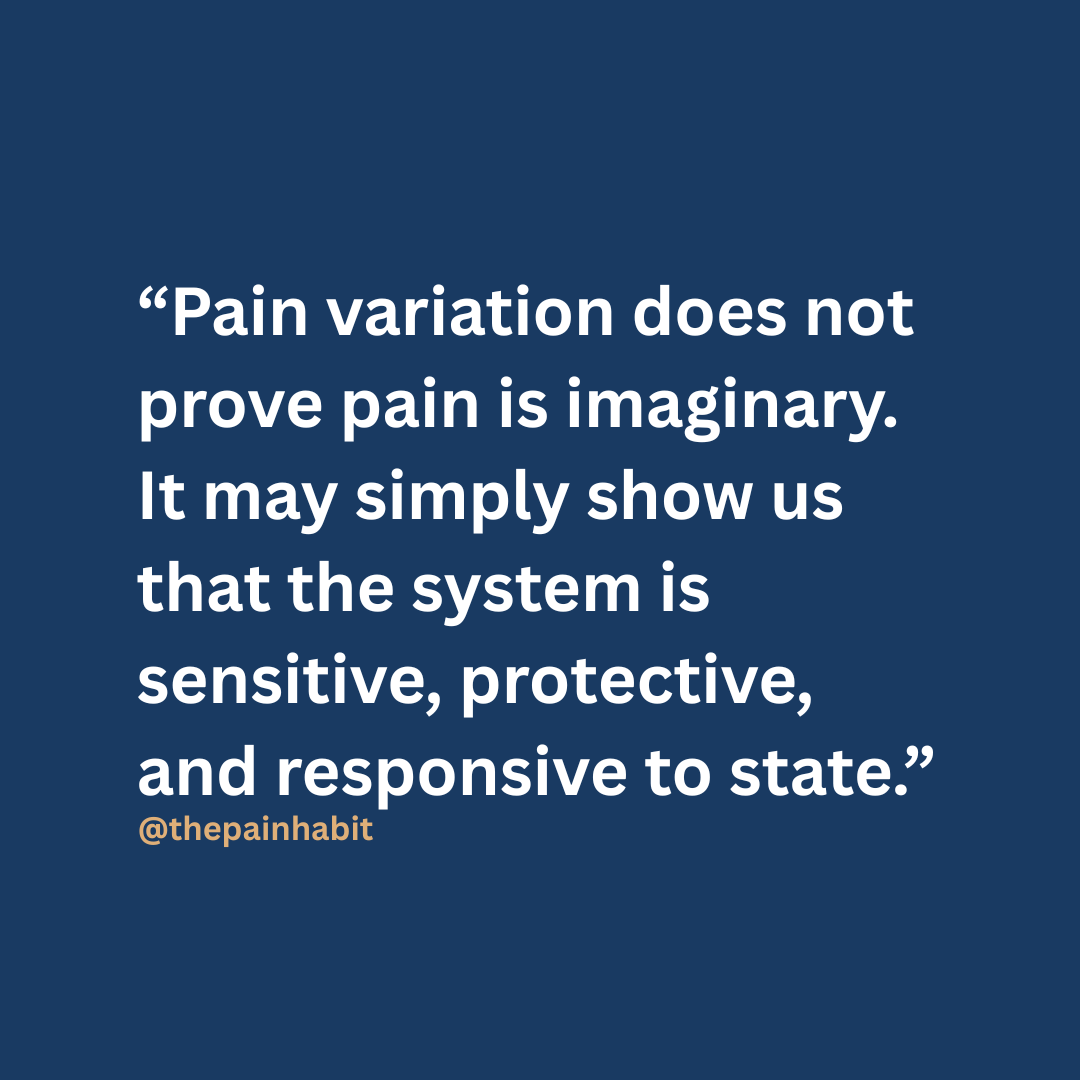
Pain is real. The interpretation may be worth questioning.
A very useful distinction is this:
The pain is real.
The meaning attached to the pain may not always be accurate.
Pain tells us that the system has decided something needs attention or protection.
But pain does not always tell us exactly how much damage exists.
This is easy to understand in everyday life.
A paper cut can hurt intensely without being dangerous.
A bruise can be sore but safe.
A scan can show wear and tear in someone with no pain at all.
A movement can feel threatening after an injury even when healing has already taken place.
The body is not a simple machine that reports damage like a warning light on a dashboard.
Pain is more complex than that.
Pain is an experience created by the brain and nervous system in response to everything it believes is relevant to protection.
That includes the body.
But it may also include memory, emotion, attention, context, confidence, uncertainty, and perceived danger.
What if pain changes during something safe?
This can be one of the most hopeful clues.
If your pain reduces during yoga, gentle movement, walking, conversation, laughter, creativity, breathing, warmth, or distraction, that does not mean the pain was fake.
It may mean your system is capable of changing state.
It may mean that under certain conditions, the body feels safer.
That matters.
The pain returning later does not erase the clue.
Many people see this as failure:
“I was fine during the class, but then it came back.”
But another way to see it is:
“My system accessed a different state for a while. That means change is possible.”
That is a very different message.
The aim is not to force the pain away.
The aim is to help the system gradually learn that safety can become more familiar, more repeatable, and more available.
What if pain stays the same?
If pain feels consistent, the question becomes slightly different.
Rather than asking, “Why does this move around?” we might ask:
What is this pain consistently linked to?
Is it pressure?
Position?
Time of day?
Fear?
Fatigue?
A specific chair?
A specific movement?
A specific belief?
A previous injury?
A diagnosis?
A warning someone once gave you?
A story you now carry about that body part?
A pain pattern that has been repeated so many times it has become automatic?
Consistency does not always mean damage.
It means there is a reliable pattern.
And reliable patterns can often be explored gently.
Sometimes they need medical assessment.
Sometimes they need physical rehabilitation.
Sometimes they need nervous system work.
Sometimes they need reassurance, graded exposure, emotional processing, or a different relationship with the body.
Often, they need a combination.
Curiosity is not dismissal
For many people in pain, being asked questions can feel threatening.
That is understandable.
Many have already felt dismissed, disbelieved, rushed, or told “nothing is wrong” when clearly something is wrong in their lived experience.
So let’s be clear.
Curiosity is not dismissal.
Exploring pain patterns does not mean blaming the person.
Questioning the meaning of pain does not mean questioning the reality of pain.
Looking at the nervous system does not mean ignoring the body.
In fact, it may be one of the most respectful things we can do.
Because it says:
Your pain is real enough to understand properly.
Your experience deserves more than a quick label.
Your body is not broken just because it is hurting.
Your nervous system may be trying to protect you.
And if the system has learned protection, it may also be able to learn safety.
The question is not “body or brain?”
People often ask:
“Is this my body, or is it my brain?”
But that may not be the best question.
The brain is part of the body.
The nervous system is part of the body.
Emotions are felt in the body.
Stress changes the body.
Sleep changes the body.
Fear changes the body.
Movement changes the body.
Inflammation, hormones, immune responses, muscle tension, breathing, attention, and memory all happen in the body.
So the question is not simply “body or brain?”
The better question may be:
What is my whole system responding to?
That gives us more room.
More compassion.
More accuracy.
And often, more hope.
A gentler way forward
If you live with persistent pain, you do not need to analyse every symptom.
You do not need to work it all out today.
You do not need to prove anything to anyone.
But you may begin to notice.
Notice what changes.
Notice what stays the same.
Notice what your system seems to fear.
Notice what helps, even briefly.
Notice what your body does when you feel under pressure.
Notice what happens when you feel safe.
Notice the difference between pain and danger.
Notice the difference between a flare and an injury.
Notice the possibility that your pain is real, but the system may still be capable of change.
Because whether pain changes or whether it feels consistent, the pattern may have something to teach us.
Not as a criticism.
Not as a test.
Not as a reason to dismiss your suffering.
But as a doorway.
A doorway into understanding.
And sometimes, that is where recovery begins.
You don’t have to figure this out alone. Here are some helpful next steps…
Join our FREE private Facebook group The Pain Habit Community, and connect with people who have recovered or are on their way.
Sign up for The Pain Habit Blog below to receive future insights.
Subscribe to The Pain HabitYouTube channelfor weekly guidance.
Buy The Pain Habit book.Order here.
But truly — take what you need, in your own time.