
Understanding Chronic Pain: Breaking the Cycle and Finding Relief
Introduction
Persistent pain is one of the most confusing and frustrating human experiences. For some, scans come back clear, suggesting “nothing is wrong,” yet the pain remains relentless. For others, scans do show changes — discs, joints, arthritis, or wear and tear — and it feels logical to believe those findings must explain the symptoms.
But correlation is not the same as causation. Many people live with those same scan findings in complete comfort, while others suffer deeply in the absence of any visible change. Both situations can mislead, leaving patients and clinicians alike searching in the wrong places.
This doesn’t make the pain any less real. It shows that persistent pain is rarely explained by structure alone. Instead, it reflects a whole-person response — a complex interplay of physical, emotional, and psychological components.
This is why so many describe their symptoms as “invisible pain.” Yet when viewed through an understanding and compassionate lens, these experiences become not only visible, but entirely logical and explainable. Far from being mysterious or hopeless, they reveal new opportunities for recovery.
This article is not a quick fix. It is an invitation to curiosity — to explore what pain really is, how the nervous system creates and maintains it, and how it can change. The very act of reading and reflecting is part of the exercise. What you gain may not only be intellectual insight, but also a shift in how your body and mind experience safety as you read.
What Pain Really Is
Pain is the body’s alarm system. Its purpose is simple: to protect us from harm.
Touch something hot — pain makes you pull away. Sprain an ankle — pain makes you rest. In these moments, pain is vital and protective.
But alarms are not perfect. A smoke alarm doesn’t only go off when there’s a fire — it sometimes sounds when you burn toast. The system is working, but it has become oversensitive.
Persistent pain is similar. The alarm keeps sounding even when there is no threat.
And this alarm responds not only to physical signals. The nervous system reacts to emotional states, memories, uncertainty, and prediction. Grief, anxiety, or even anticipating conflict can activate the same pathways as physical injury.
An injury, by definition, is not only physical — it is emotionally upsetting. Some people openly acknowledge this. Others, shaped by earlier life circumstances, learned to suppress fear or vulnerability. They may deny the emotional impact, or be unaware of the ways they push it down.
This isn’t a flaw — it is a coping strategy formed during earlier challenges. It can become so familiar that it feels like identity. But it’s not who the person truly is — it is who they learned to be.
These are often the people who “run fast” in life: physically, emotionally, psychologically. They cope by pushing, achieving, absorbing, enduring — until one day a symptom appears out of nowhere and refuses to go.
Pain becomes a failsafe — a protective pause. A moment the nervous system forces, because unconsciously it senses overload.
This pause feels uncomfortable, like life is on hold. Familiar ways of coping — keeping busy, controlling outcomes, suppressing feelings — no longer work. And until safety is rebuilt slowly and consistently, the system holds that protective pattern in place.
This article aims to articulate that experience in a way that validates your reality, explains it logically, and opens space for a different relationship with pain — one that leads toward recovery.
How the Nervous System Learns Pain
The nervous system is not fixed. It adapts continuously — a process called neuroplasticity.
When pain signals repeat, the system becomes more efficient at producing them. Pathways strengthen like well-trodden tracks. Eventually, even small triggers — a movement, a thought, or a moment of stress — can activate the entire protective response.
Pain becomes a habit. Not a conscious habit — a neurological one.
If an injury happens during emotional distress, the nervous system wires the physical sensation together with the emotional state. Fear, shock, or overwhelm become part of the memory.
Over time, the injury heals, but the associations remain.
Threat Without Injury
The nervous system encodes emotional threats with the same weight as physical danger.
Humiliation, rejection, intimidation, exclusion — these experiences create powerful protective learning.
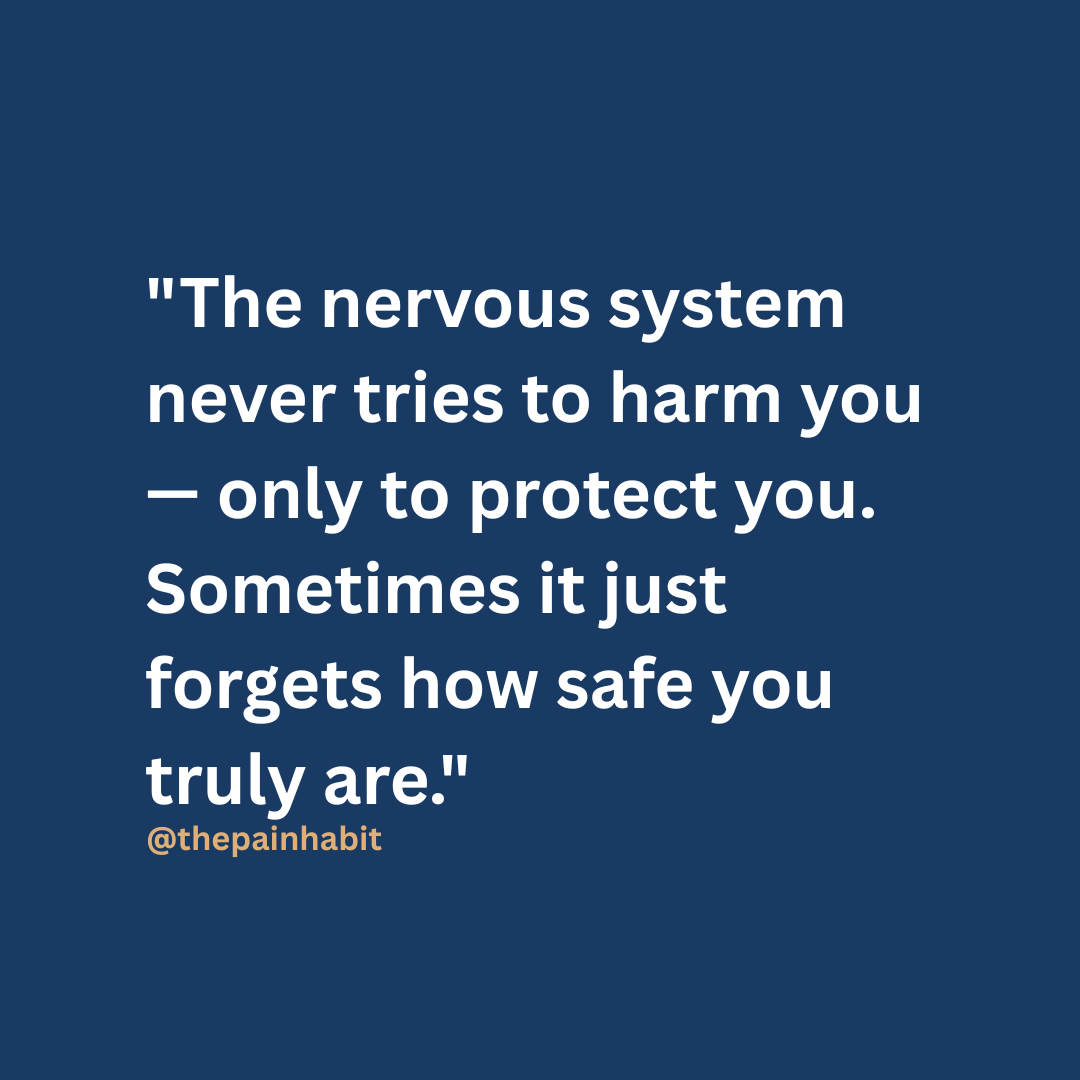
This is why someone can feel pain when there is no damage. The system has learned that certain situations, feelings, or memories are unsafe.
The Illusion of the Monster
Persistent pain feels like a monster — unpredictable, overpowering, and outside your control.
But like the Wizard of Oz, the monster is an illusion created by a frightened system behind a curtain. The nervous system tries to protect you by appearing fierce.
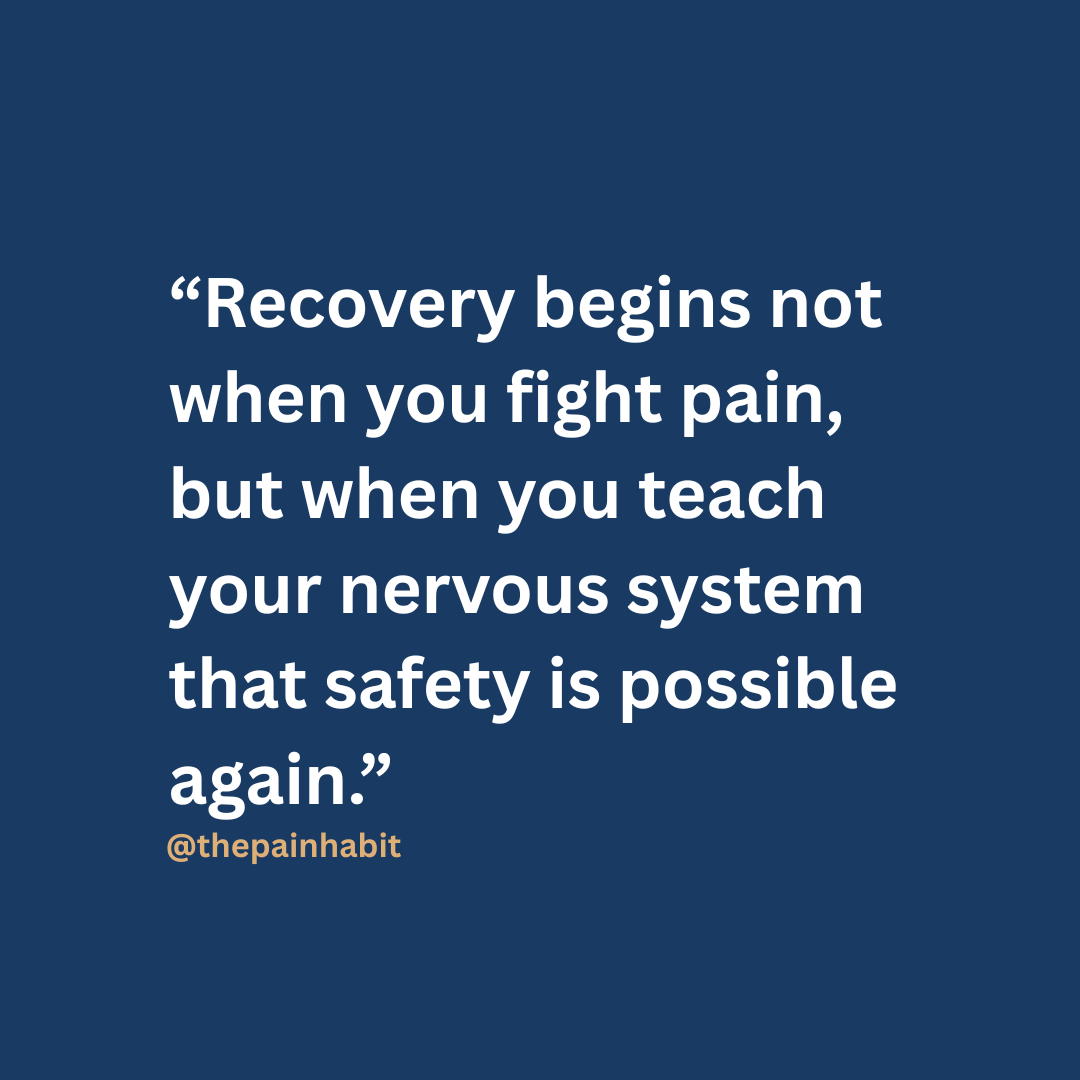
Recovery begins when you step behind the curtain and discover that the “monster” is a protective part of you needing reassurance, not fear.
Why Pain Persists
If the threat has passed, why doesn’t the system reset?
Because its priority is survival.
When the nervous system learns something was dangerous — emotionally or physically — it stores that learning as if future danger is likely. It errs on the side of safety, even if that safety is uncomfortable.
Who You Had to Be
Persistent pain is often linked not just to events, but to the roles people played to survive:
the achiever
the helper
the carer
the strong one
the “fine” one
the one who never rests
These strategies once kept you safe, but in adulthood they may keep your nervous system on constant alert.
The Denial of Denial
Some people know they are overwhelmed.
Others genuinely believe they are fine — but their bodies tell a different story.
This is not deception. It is survival. The system hides distress to protect you from feeling it. Pain often becomes the only signal that something needs attention.
Not Only in Trauma
Persistent pain does not require a tragic past.
It also appears in people with happy, loving families — because no child gets every need met, every moment.
Children sense:
the tear behind a parent’s smile
the tension behind a quiet withdrawal
the worry adults don’t speak about
These subtle gaps teach coping strategies:
More pleasing, more caring, more hiding, more responsibility.
These adaptations are acts of love — not dysfunction.
But they shape how the nervous system learns safety and threat.
Pain as a Failsafe
When old patterns drive someone toward overload, pain steps in to halt the momentum. It forces rest when rest has been impossible.
This is why pain so often feels like a trap.
It is not the body failing — it is the body protecting.
A Path Forward
When safety returns — bit by bit, consistently — the system recalibrates.
Not because you force it, but because protection is no longer needed.
Persistent pain is not weakness.
It is evidence that you survived something your system didn’t yet know how to integrate.
And integration is possible.
Breaking the Cycle
If persistent pain is an overprotective alarm, recovery is teaching the system that safety is possible again.
This is not a single breakthrough — it is slow, repeated reassurance.
Curiosity Instead of Fear
The moment you ask,
“What is my system protecting me from right now?”
instead of
“What is wrong with me?”
The entire tone shifts.
Curiosity softens fear.
Fear strengthens the alarm.
Sending Safety Signals
Small signals matter:
slowing your breath
grounding your feet
softening your shoulders
reframing pain as protection, not threat
Each act becomes a drop of safety that accumulates over time.
Gentle Exposure
Instead of avoiding feared movements or sensations, approach them gently.
Visualise first.
Move slightly next.
Allow safety to be present, even in the face of discomfort.
This teaches the system flexibility instead of rigidity.
Making Space for Emotion
Unfelt emotions often sit beneath persistent pain.
Not because emotions are dangerous — but because they were never given safe expression.
Allowing a moment of honesty — “this hurts emotionally” — often softens the physical alarm.
The Power of Consistency
Nothing is wasted.
Every moment of curiosity, every softened breath, every act of self-honesty teaches the nervous system something new.
Recovery is a series of small signals repeated consistently, not a single dramatic shift.
A Shift in Belief & Recovery Is Not Perfection
Recovery from persistent pain does not require perfection.
It requires a shift — often subtle, often slow — in what you believe the pain means.
Many people assume recovery will only begin once the pain fully disappears.
But it’s the other way around.
Recovery begins when pain is no longer interpreted as threat.
When the meaning changes, the experience changes.
Pain that once felt like a warning of damage begins to feel like a signal of protection.
A moment to pause.
A moment to breathe.
A moment to recognise a familiar pattern emerging — and choose something different.
The Beliefs That Hold Pain in Place
Three beliefs, in particular, tend to hold persistent pain in place:
“Something must be wrong with my body.”
“Pain means I can’t cope.”
“I must avoid anything that triggers symptoms.”
Each of these beliefs makes perfect sense.
Each is understandable.
And each can be softened.
Not by forcing positivity — but by opening just enough space to consider a different possibility:
What if nothing is structurally wrong?
What if pain is a protective habit rather than a sign of damage?
What if my body is capable, even if my nervous system is cautious?
What if I can approach challenges gradually instead of avoiding them entirely?
These are not affirmations.
These are questions — openings — that allow the nervous system to gently update its predictions.
Setbacks Are Not Failure
Because pain is learned through repetition, it also fades through repetition.
This process is not linear.
There will be days when symptoms ease effortlessly.
And days when the system reverts to old protective patterns.
This is not failure.
This is learning.
Imagine teaching a frightened animal that the world is safe.
It will test, retreat, advance, and hesitate.
Your nervous system behaves the same way — cautious at first, then gradually more trusting.
The aim is not to avoid flare-ups.
The aim is to recognise them for what they are:
Moments of protection, not moments of damage.
Relief Comes From Relationship, Not Force
When you stop fighting pain and start relating to it differently — with curiosity, with patience, with a sense of internal safety — the alarm system gradually calms.
Relief is not something you chase.
It’s something that emerges in the absence of pressure.
This is why perfectionism blocks progress.
The nervous system cannot feel safe if recovery becomes another thing you “must” do perfectly.
You cannot coerce a frightened system into calm.
You can only meet it with steady reassurance — the same way you would reassure a scared child, a distressed friend, or an anxious animal.
And slowly, it learns.
A Change in Identity
For many people, recovery involves a shift in identity:
from the one who copes, pushes, performs, hides, or endures…
to the one who listens, feels, rests, and chooses with intention.
Not because of weakness.
But because the old strategies were built for a different time.
For a different environment.
For protection, not for living.
Recovery is a return — not to who you were conditioned to be, but to who you actually are underneath it.
Final Words & Closing
Persistent pain can feel like the most personal form of suffering.
It narrows life. It erodes confidence. It blurs the line between who you are and what you feel.
It can make you question your strength, your future, and even your identity.
But nothing about persistent pain means you are broken.
If anything, it shows how fiercely your nervous system has been working to keep you safe — at times too fiercely, yes, but always with the same intention: protection.
Recovery does not come from fighting the body or forcing it to behave.
It comes from recognising what the body has been trying to do all along.
From understanding the alarm, rather than fearing it.
From listening to what the system is asking for, rather than pushing through it.
From gently teaching safety, instead of demanding silence.
There is a part of you — behind the fear, beneath the symptoms, underneath the layers of conditioning — that has never been damaged, never been broken, and never been lost.
That part is the one capable of recovering.
You don’t have to get everything right.
You don’t need perfect clarity or perfect conditions.
And you certainly don’t need to become a different person.
You need to meet yourself where you are, with honesty and compassion, and take the next small step toward safety, awareness, and choice.
Pain is not a life sentence.
It is a message from a nervous system doing its best with the tools it has.
And those tools can change.
Recovery is not about going back — it's about going forward with a different understanding.
A relationship with yourself built on gentleness rather than fear.
Intention rather than habit.
Curiosity rather than dread.
In that space, change is not only possible — it is inevitable.
And it begins, quite simply, with noticing that you are already here, reading these words, considering new possibilities, making space for a different experience.
That is the first step.
And it is more than enough.
You don’t have to figure this out alone. Here are some helpful next steps…
Join our FREE private Facebook group, The Pain Habit Community, and connect with people who have recovered or are on their way..
Sign up for The Pain Habit Blog below to receive future insights.
Subscribe to The Pain Habit YouTube channel for weekly guidance.
Buy The Pain Habit book. Order here.
But truly — take what you need, in your own time.