
Why Can Pain Stay Even When Nothing Is Wrong?
One of the hardest things about persistent pain is that it can continue even when nothing obvious seems to be wrong.
You may have rested.
You may have had scans.
You may have seen professionals.
You may have been told there is no serious damage.
You may even understand, logically, that your body is safe.
And yet the pain is still there.
That can feel confusing, frustrating, and at times deeply unfair.
It can leave people asking:
“If nothing is wrong, why does it still hurt?”
And that question matters.
Because persistent pain is rarely helped by simply being told, “There’s nothing wrong.”
For many people, that phrase can feel dismissive. It can sound as though the pain is being minimised, imagined, or brushed aside.
But that is not what this means.
Pain is always real.
The question is not whether the pain exists.
The question is why the system is still producing it.
Pain Is Not Just a Damage Signal
Most of us grow up with a very simple model of pain.
Something is injured.
The body sends a warning signal.
The pain tells us where the problem is.
That model is useful in many situations.
If you cut your finger, twist your ankle, or touch something hot, pain helps you protect yourself.
But persistent pain often behaves differently.
It can continue long after tissues have healed.
It can fluctuate without a clear physical reason.
It can move around the body.
It can increase during stress, tiredness, uncertainty, or fear.
It can reduce when we feel safe, distracted, reassured, or emotionally lighter.
That does not mean the pain is fake.
It means pain is more than a simple damage meter.
Pain is an output of the nervous system.
It is influenced by the body, yes — but also by memory, meaning, emotion, stress, expectation, fear, attention, previous experience, and the brain’s best prediction about whether protection is needed.
The Body Can Be Safe While the System Still Feels Threatened
This is one of the most important shifts in understanding persistent pain.
The body may not be in danger.
But the nervous system may still be behaving as though it is.
That can happen for many reasons.
Perhaps the original injury was frightening.
Perhaps recovery took longer than expected.
Perhaps a scan result gave the pain a more serious meaning.
Perhaps someone said, “You’ll have to be careful with that.”
Perhaps the pain appeared during a stressful time in life.
Perhaps your system has learned to associate certain movements, positions, places, or situations with threat.
Over time, the nervous system can become more protective.
Not because you are weak.
Not because you are imagining it.
Not because you have done something wrong.
But because the system has learned.
And what the nervous system learns, it can also unlearn.
Pain Can Become a Habit of Protection
This is where the idea of The Pain Habit becomes useful.
A habit is not a choice.
It is not something you consciously decide to do.
It is something the system has repeated often enough that it becomes familiar, automatic, and efficient.
Pain can sometimes work in a similar way.
The nervous system becomes used to producing pain in certain contexts.
Bending.
Sitting.
Walking.
Resting.
Going on holiday.
Feeling under pressure.
Finally stopping after being busy.
Doing something you believe might be harmful.
The pain may feel as though it proves something is wrong in the body.
But sometimes it is showing us that the nervous system has become very good at predicting danger.
Even when danger is no longer present.
That is not a fault.
It is protection that has become overprotective.
Why Reassurance Alone Often Isn’t Enough
Many people with persistent pain have already been reassured.
They have been told their scan is “normal for their age.”
They have been told nothing serious has been found.
They have been told to keep moving, relax, or not worry.
But reassurance often fails when the body still feels unsafe.
That is because understanding something intellectually is not always the same as feeling safe physiologically.
You can know something in your mind and still feel something different in your body.
You can understand that movement is safe and still brace before doing it.
You can believe there is no damage and still scan your body for signs of pain.
You can want to relax and still feel your system gripping, guarding, or preparing.
This is not failure.
It is simply the difference between thinking safety and experiencing safety.
Recovery often involves helping the body and nervous system experience safety again — slowly, repeatedly, and compassionately.
This Is Not “All in Your Head”
This point is important.
When pain is linked to the nervous system, stress, fear, or emotion, some people worry that this means the pain is psychological or imagined.
It does not.
The nervous system is biological.
The brain is biological.
Stress responses are biological.
Protective patterns are biological.
Learned pain responses are biological.
Your experience is real.
The pain is real.
But the cause may not be ongoing damage.
That distinction can open a door.
Because if pain is being produced by a protective system, rather than by an injured structure, then recovery is not about fixing a broken body.
It is about changing the conditions that keep the system on alert.
What Helps Pain Begin to Settle?
Persistent pain often begins to change when the system receives new evidence.
Not just once, but repeatedly.
Evidence that movement is safe.
Evidence that pain can fluctuate.
Evidence that symptoms do not always mean harm.
Evidence that the body is not as fragile as feared.
Evidence that emotions can be felt without being dangerous.
Evidence that rest, movement, connection, and confidence can return.
This can happen through education, movement, somatic tracking, graded exposure, emotional awareness, nervous system regulation, and compassionate self-understanding.
It is rarely about forcing pain away.
It is more often about helping the system no longer need it.
A Gentle Question to Consider
Instead of asking:
“What is wrong with me?”
It may help to gently ask:
“What might my system still be trying to protect me from?”
That does not mean there is always one simple emotional cause.
It does not mean you need to dig endlessly into the past.
And it certainly does not mean blaming yourself.
It simply creates a little space.
A space where pain is not treated as proof of damage, but as a protective response that may be open to change.
Final Thought
Pain can stay even when nothing is wrong because pain is not only about what is happening in the tissues.
It is about what the nervous system believes is needed.
Sometimes the body has healed, but the warning system has not yet updated.
Sometimes the structure is safe, but the meaning still feels threatening.
Sometimes the problem is not damage, but protection that has become stuck.
And when we understand that, recovery can begin to feel less like a battle with the body and more like a process of gently teaching safety again.
Not through force.
Not through denial.
But through calm, curious, compassionate practice.
Mid-Blog Quote Image
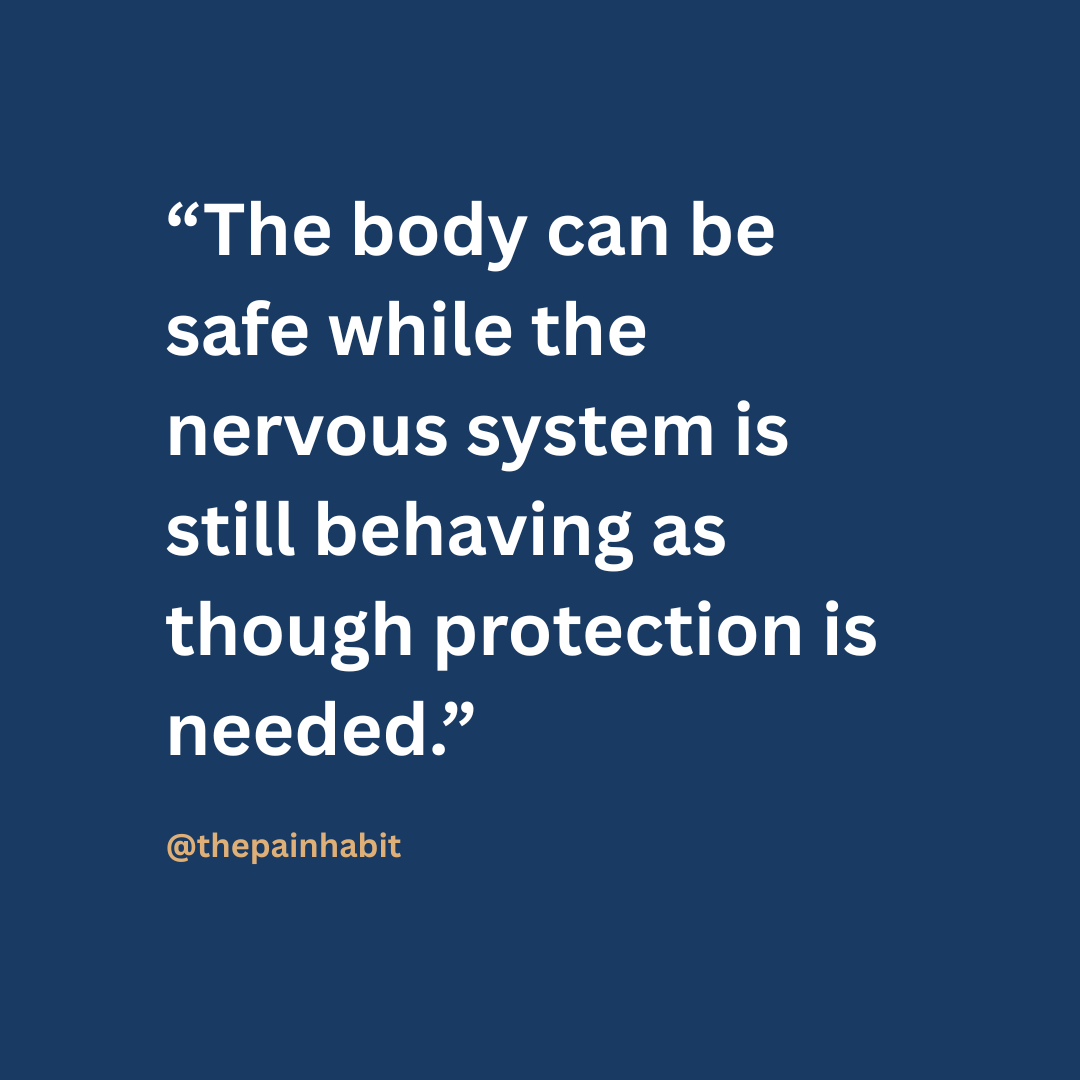
“The body can be safe while the nervous system is still behaving as though protection is needed.”
Alternative:
“Persistent pain is not proof that your body is broken. Sometimes it is proof that your system has learned to protect.”
Squarespace SEO
SEO Title:
Why Can Pain Stay Even When Nothing Is Wrong? | The Pain Habit
URL Slug:
why-can-pain-stay-even-when-nothing-is-wrong
Meta Description:
Persistent pain can continue even when the body is safe. Learn why pain may stay after healing and how the nervous system can learn protection.
Blog Excerpt:
Suggested Tags:
persistent pain, chronic pain, nervous system, pain recovery, pain education, neuroplastic pain, mind body pain, pain habit, pain neuroscience, chronic pain recovery, somatic tracking, pain and safety
FAQs
Can pain be real if nothing is damaged?
Yes. Pain is always real. But pain does not always mean there is ongoing damage. Persistent pain can be produced by a protective nervous system that has learned to stay on alert.
Why does pain continue after healing?
Pain can continue after healing when the nervous system still predicts threat. This may be influenced by fear, stress, previous pain experiences, protective habits, or the meaning attached to symptoms.
Does this mean my pain is psychological?
No. Nervous system pain is biological, not imagined. The brain, body, stress system, emotions, and protective responses all interact physically to shape the pain experience.
You don’t have to figure this out alone. Here are some helpful next steps…
Join our FREE private Facebook group The Pain Habit Community, and connect with people who have recovered or are on their way.
Sign up for The Pain Habit Blog below to receive future insights.
Subscribe to The Pain HabitYouTube channelfor weekly guidance.
Buy The Pain Habit book.Order here.
But truly — take what you need, in your own time.